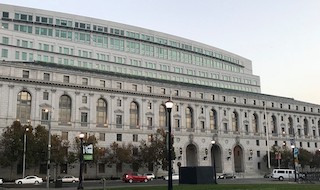
 Court of Appeal First Appellate District San Francisco
The underlying allegation in the new case was that Noah S. grabbed the purse of Jacqueline E., age 88, as she was preparing to get into the passenger side of her car. As he tried to grab the purse, Jacqueline E. held onto the purse and falls to the ground while Noah S. was running away holding onto the purse as well. Noah pulled Jacqueline E. a few feet before abandoning his attempted robbery. Jacqueline E. also rolled over after falling on the ground. She suffered a mild concussion and had a hematoma to the side of her head about the size of a quarter and blood in her hair nearby. She had no memory of the incident.
Her husband, Phillippe E., was loading his walker into the driver’s side of his car and did not see the commotion, but he found his wife laying on the pavement alongside his car. A surveillance video from a restaurant nearby, that the older couple had just exited after having lunch there, recorded the whole incident. After Jacqueline was dragged to the ground and Noah let go of the purse, Jacqueline laid motionless on the ground for about ten seconds. There was a blood stain on the pavement four inches long by two inches wide from Jacqueline’s bleeding.
After considering the evidence, the juvenile court sustained the petition on the new charges and found the attempted robbery qualified as an offense under Welfare & Institutions Code § 707(b). It then committed Noah to a juvenile ranch facility for 12 months with a 180 day “aftercare period.”
The First Appellate District Court observed that this contention presented a pure issue of statutory interpretation, which it reviews “de novo” (meaning all over, without any obligation to follow a lower court’s ruling). People v. Gonzalez (2017) 2 Cal. 5th 1138, 1141.
The court began its interpretation by noting that its “fundamental task is to determine the Legislature’s intent so as to effectuate the law’s purpose,” starting with examination of the statute’s words, “giving them a plain and commonsense meaning.” When the language of the statute is clear, the appellate court needs to go no further.
But where a statute’s terms are unclear or ambiguous, the court will “look to a variety of extrinsic aids, including the ostensible objects to be achieved, the evils to be remedied, the legislative history, public policy, contemporaneous administrative construction, and the statutory scheme of which the statute is a part.” People v. Harrison (2013) 57 Cal. 4th 1211, 1221-1222.
Here, Welfare & Institutions Code § 707(b) provides: “This subdivision is applicable to any case in which a minor is alleged to be a person described in Section 602 by reason of the violation of one of the following offenses,” including “[a]n offense described in Section 1203.09 of the Penal Code.”
Section 1203.09(a) provides “[n]otwithstanding any other law, probation shall not be granted to, nor shall the execution, or imposition of sentence be suspended for any person who commits or attempts to commit one or more of the crimes listed in subdivision (b) against a person who is 60 years of age or older; or against a person who is blind, a paraplegic, a quadriplegic, or a person confined to a wheelchair and that disability is known or reasonably should be known to the person committing the crime; and who during the course of the offense inflicts great bodily injury upon that person.” Section 1203.09(b)(2) provides that subdivision (a) applies to the crime of robbery.
The First Appellate District therefore found under the plain language of the statutes, an attempted robbery against the particular types of victims specified in § 1203.09, i.e., a victim over 60, where the perpetrator inflicts great bodily injury, is an offense described in 1203.09 and therefore qualifies as an offense under Welfare & Institutions Code § 707(b).
Therefore, the First Appellate District Court affirmed the juvenile court’s rulings.
The citation for the First Appellate District Court ruling discussed above is In re Noah S. (1st App. Dist., 2021) 67 Cal. App. 5th 410, 282 Cal. Rptr. 3d 204.
For more information about juvenile offenses, please click on the following articles:
 Greg Hill & Associates Home















 Juvenile Court Sign
 Your Privacy Choices Cookie Policy Manage Cookies